
For most injured athletes, the traditional physiotherapy experience ends with a familiar—and frustrating—send-off: "Your strength looks good on the table. Good luck out there."
Yet for a baseball pitcher stepping back onto the mound, or a sprinter exploding out of the blocks, passing a basic table test doesn't answer the question that matters most: Am I actually ready to perform at full speed?
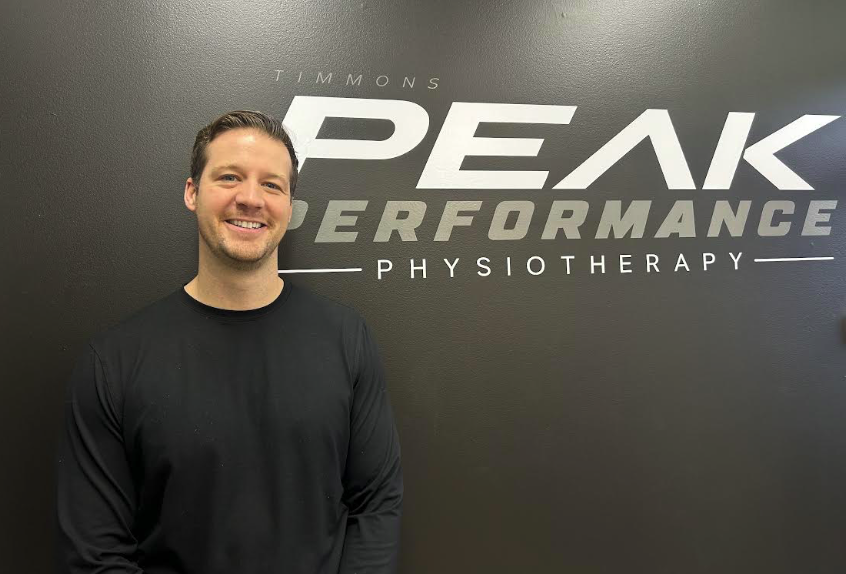
That missing link is exactly why Lower Sackville native Cody Timmons launched Peak Performance Physiotherapy—bringing a metric-driven, collegiate- and pro-style athletic recovery model to Nova Scotia.
Built by an Athlete, Backed by Science
Cody’s approach to rehabilitation was shaped long before he stepped into a clinic. Growing up in Lower Sackville playing everything from baseball and volleyball to basketball, soccer, and football, he went on to play five years of varsity volleyball at the University of New Brunswick—winning three banners, representing Nova Scotia at the 2012 Canada Games, and earning UNB’s prestigious Garnet Copeland Award for top all-around student-athlete.
After completing a kinesiology degree (with an unexpected business minor that recently came in handy), earning his Master of Physiotherapy at Dalhousie University, and spending seven years in a fast-paced, high-volume clinic, Cody saw firsthand how traditional rehab often falls short for competitive athletes. Juggling two or three patients at once meant less one-on-one time—and vague, guesswork-heavy timelines for returning to play.
Taking the Guesswork Out of Recovery: The 5-Phase System
Rather than relying on arbitrary timelines ("You'll probably be back in six weeks"), Peak Performance Physiotherapy uses an objective, 5-phase progression. Athletes don't advance until they hit clear, measurable benchmarks:
Phase 1: Calm the Tissue & Manage Inflammation – Reducing pain and restoring baseline symmetry between the injured and uninjured joint.
Phase 2: Restore Mobility – Regaining roughly 90% range of motion in all directions.
Phase 3: Build Strength Capacity – Reaching a 90% Limb Symmetry Index (matching strength compared to the uninjured side). While standard clinics often discharge athletes here, Peak Performance treats this as the halfway point.
Phase 4: Rate of Force Production – Measuring not just how strong an athlete is, but how fast they can express that strength—translating raw force into athletic power.
Phase 5: Motor Control & Neurocognitive Readiness – Reintroducing sport-specific decision-making before live competition. Using tools like virtual reality simulations, a recovering pitcher can stand on a virtual rubber, check a runner at first, react to verbal cues, and train their brain for game speed long before throwing a live fastball.
When athletes have concrete numbers to hit at every stage, rehab stops feeling like a waiting game and becomes an active, goal-driven process. More importantly, checking off objective metrics gives athletes genuine confidence when they finally step back onto the field.
From the Treatment Table to the Turf—Under One Roof
East Coast athletes are making their mark at the highest levels of baseball, hockey, and basketball, and Cody believes local sports medicine needs to match that caliber.
With a dedicated strength and conditioning gym opening alongside the clinic—and access to turf, a pitching rubber, and home plate at The Dugout—athletes at Peak Performance can move seamlessly from hands-on treatment to heavy strength work, and finally to full-speed throwing, sprinting, or swinging under one roof.
Looking ahead, Cody plans to expand the clinic into a multidisciplinary performance hub with massage therapy, chiropractic care, osteopathy, and even high-speed motion-capture biomechanics to pinpoint "energy leaks" in an athlete's mechanics.
At Peak Performance Physiotherapy, the goal isn't just getting you out of pain—it's making sure you return to your sport stronger, faster, and more resilient than when you left.